Let AI help. Keep your rules.
Run Sekrello between your application and its AI provider. Choose how sensitive information in each request is handled: allow it, redact it, or stop the request. Each action is recorded with metadata.
For backend text-chat workflows in an environment your team operates.
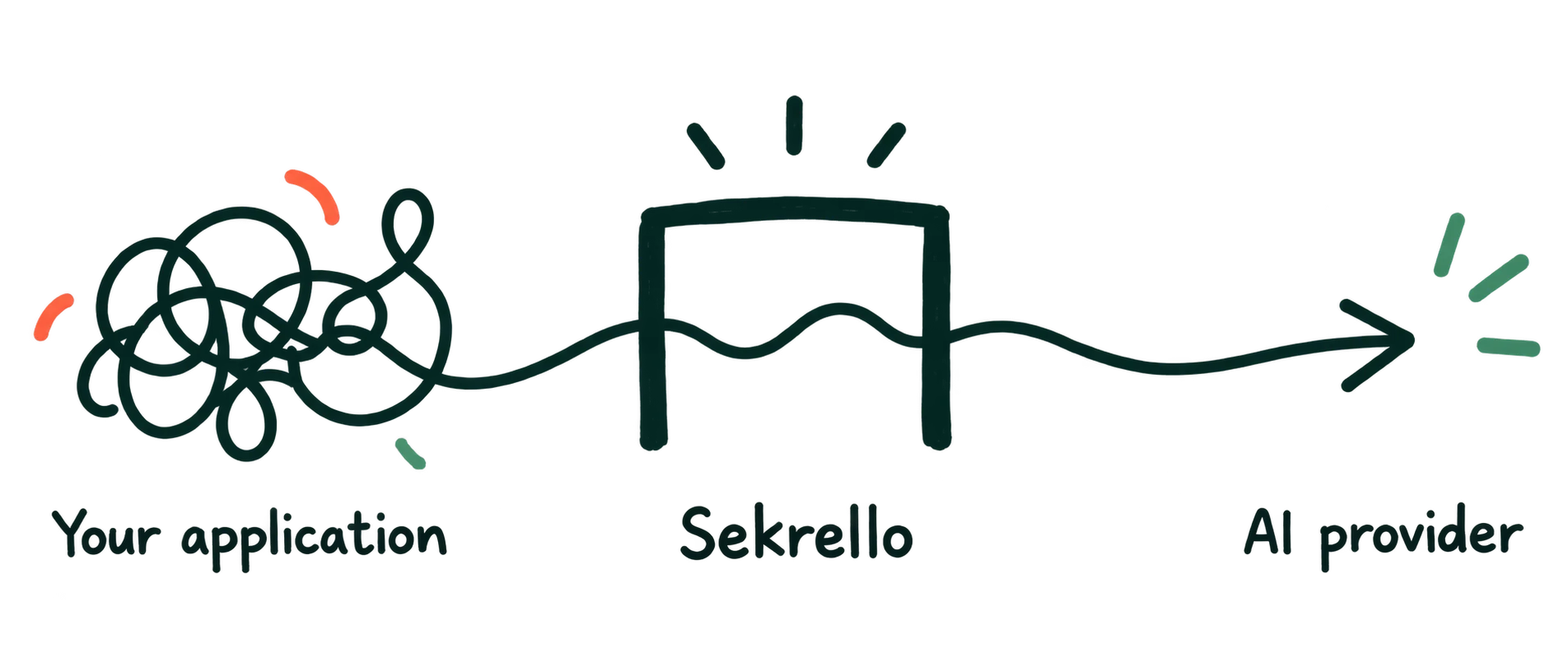
- Your application
- SekrelloYour policy
- AI provider
Choose what reaches the provider.
Control how sensitive information is handled, down to the category and the confidence needed to act.
Different information. Different rules.
Redact an email address, block a credential, or let the rest through. Choose how each category is handled.
Your threshold for action.
Choose how confident a detection needs to be before a category’s rule applies. Different categories can have different thresholds.



Example request
Draft a short agenda for Thursday’s customer review. Contact: [REDACTED].
Keep a clear record.
Review the decisions and outcomes, without storing the conversation in the audit trail.
- When
- See when a request was recorded.
- Which request
- Follow one request when you need to investigate.
- What your rules decided
- See whether the request was allowed, redacted, or blocked.
- How it ended
- Check the recorded result, including requests that failed.

Audit record
- Time
- 09:41:12
- Request
- 8c1e·4f2a
- Result
- Redacted
- Reason
- Redacted by policy
- Found
- 1 email address
- Conversation
- Not stored
Your infrastructure. Your call.
Keep the gateway in an environment your team operates, with control over access and records.
- Where it runs. Deploy and operate Sekrello on infrastructure you control.
- Who can connect. Create and revoke the access keys your applications use.
- Where records stay. Keep saved policies and audit records in your Sekrello environment.
You choose the AI provider and manage that separate connection.

Questions, answered.
What changes for our application?
Your backend application connects to Sekrello instead of directly to its AI provider. Your team manages the policy and provider connection in the environment you operate. Sekrello applies your rules to the request before it goes to the provider.
Can different information follow different rules?
Yes. You choose how the information covered by your policy is treated: Allow, Redact, or Block. For example, you can redact email addresses while blocking credentials. If several rules match one request, Block takes precedence over Redact, then Allow.
What stays under our control?
Your team operates Sekrello, manages its policies, and chooses the AI provider. Information your policy permits can still go to that provider; its processing and retention remain separate from Sekrello.
What happens to the AI’s reply?
It comes straight back to your application. Streamed replies arrive as the provider writes them, while Sekrello checks that each part is well-formed and records the outcome in the audit log. Your rules decide what goes out; the reply itself comes back unchanged.
Is our text sent anywhere to be checked?
No. Sekrello checks each request inside your own environment, before anything goes to the AI provider. Your text isn’t sent to an outside service for inspection.
Does Sekrello store our conversations?
No. The audit log records what your rules decided and how each request ended, never the prompt, the redacted text, the AI’s reply, or the values that matched.
Can we check a policy without contacting the AI provider?
Yes. Your team can check the active policy with synthetic examples without sending them to an AI provider. Use those checks to see how the chosen rules behave. Detection can miss or misidentify sensitive information. Evaluate the categories and languages your workflow uses.
Is Sekrello right for our workflow?
The current development version supports backend text chat through the OpenAI-compatible Chat Completions API, in an environment your team operates with one local administrator. Consumer AI websites, tool use, and image or audio inputs are outside the current scope. Tell us what your workflow needs and we’ll assess it together.

Bring your AI workflow.
Tell us what your application does, where its AI requests go, and which kinds of information you want to protect. We’ll help you assess the fit and what to verify.